
Jun 26
Google Discover Is Becoming More Important as Search Traffic Changes
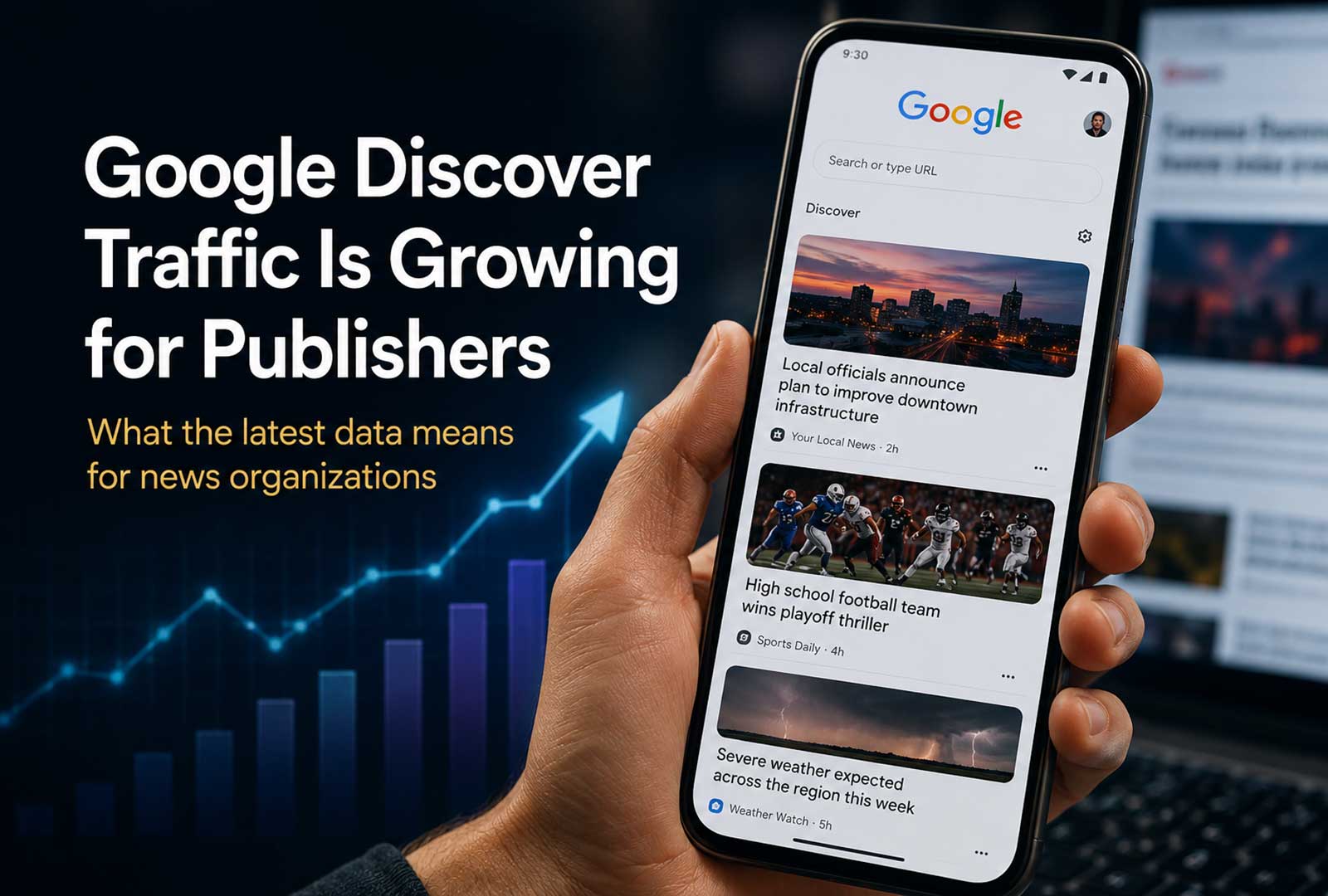
If you spend any time talking with publishers right now, you’ll hear the same concern over and over again.
Search traffic isn’t what it used to be.
Some publishers blame AI Overviews. Others point to changes in Google’s search results. Most simply know that the traffic strategies that worked five years ago are producing very different results today.
That’s why a recent report highlighted by Press Gazette caught our attention. According to the report, many U.S. publishers are seeing meaningful traffic growth from Google Discover, particularly around breaking news and timely content.
For an industry searching for reliable audience growth, that’s worth paying attention to.
Discover Isn’t Search
Google Discover behaves differently from traditional search.
Readers don’t type in a question. They don’t compare search results. They don’t even necessarily know they’re looking for a particular story.
Instead, Google places content directly into a personalized feed based on interests, browsing habits, location, and current events.
For publishers, that changes the game.
A great story no longer has to wait for someone to search for it. If Google believes the content is relevant, it can place that story directly in front of a potential reader.
For news publishers, that can mean significant bursts of traffic when a story aligns with what audiences are actively consuming.
Why This Matters for Local News
One thing that stands out about the Discover conversation is how well it aligns with the strengths of local journalism.
Local publishers produce original reporting. They attend city council meetings. They cover local elections. They break stories that nobody else has.
Those advantages matter.
AI can summarize information. Large media organizations can aggregate information. Neither can easily replace the publisher who was actually at the meeting or spoke directly with the source.
If Discover continues rewarding original reporting and timely coverage, local publishers may be better positioned than many people realize.
The Real Story Isn’t Discover
The bigger takeaway isn’t that Google Discover is suddenly the answer to every publisher’s traffic problems.
The real story is that traffic is becoming increasingly fragmented.
A decade ago, publishers could focus heavily on search and social media. Today, audience growth might come from Google Discover, NewsBreak, newsletters, direct traffic, social media, push notifications, or increasingly, AI-powered search experiences.
Tomorrow it may come from somewhere else entirely.
That reality creates both opportunity and risk.
Discover traffic can be powerful, but publishers don’t control Discover. The same is true for Facebook, Google Search, NewsBreak, and every other platform that sends visitors to a website.
Building a business around any single traffic source has become increasingly dangerous.
What We’re Seeing
One advantage we have at Content Credits is that we’re seeing the industry from multiple angles at the same time.
We operate our own publication through The Cincinnati Exchange. We work with independent publishers and newspaper groups. We spend a significant amount of time tracking how content performs across search, social media, NewsBreak, and emerging AI platforms.
What we’re seeing is fairly consistent.
Publishers that continue producing original reporting and serving a clearly defined audience are still finding ways to grow.
The channels may be changing, but demand for quality content hasn’t disappeared.
If anything, the value of original journalism appears to be increasing as AI-generated content becomes more common across the internet.
The Next Challenge: Monetization
Traffic is only part of the equation.
The harder question is how publishers convert that traffic into revenue.
A reader arriving from Google Discover may never become a subscriber. They may read a single article and not return for weeks.
That doesn’t mean the visit has no value.
Publishers are increasingly experimenting with memberships, donations, article unlocks, micropayments, subscriptions, and other reader-revenue models that give audiences more ways to support the journalism they consume.
As audience acquisition becomes more diverse, monetization strategies will likely become more diverse as well.
We’ll Be Watching
The publishing industry is changing faster than it has in years.
Search is evolving. AI is reshaping how information is discovered. Reader habits continue to shift. New distribution channels are emerging while old ones become less predictable.
For publishers, staying informed is becoming just as important as staying visible.
We’ll continue tracking these trends, sharing what we’re seeing, and highlighting developments that matter to publishers as the industry adapts to its next chapter.