
Sep 26
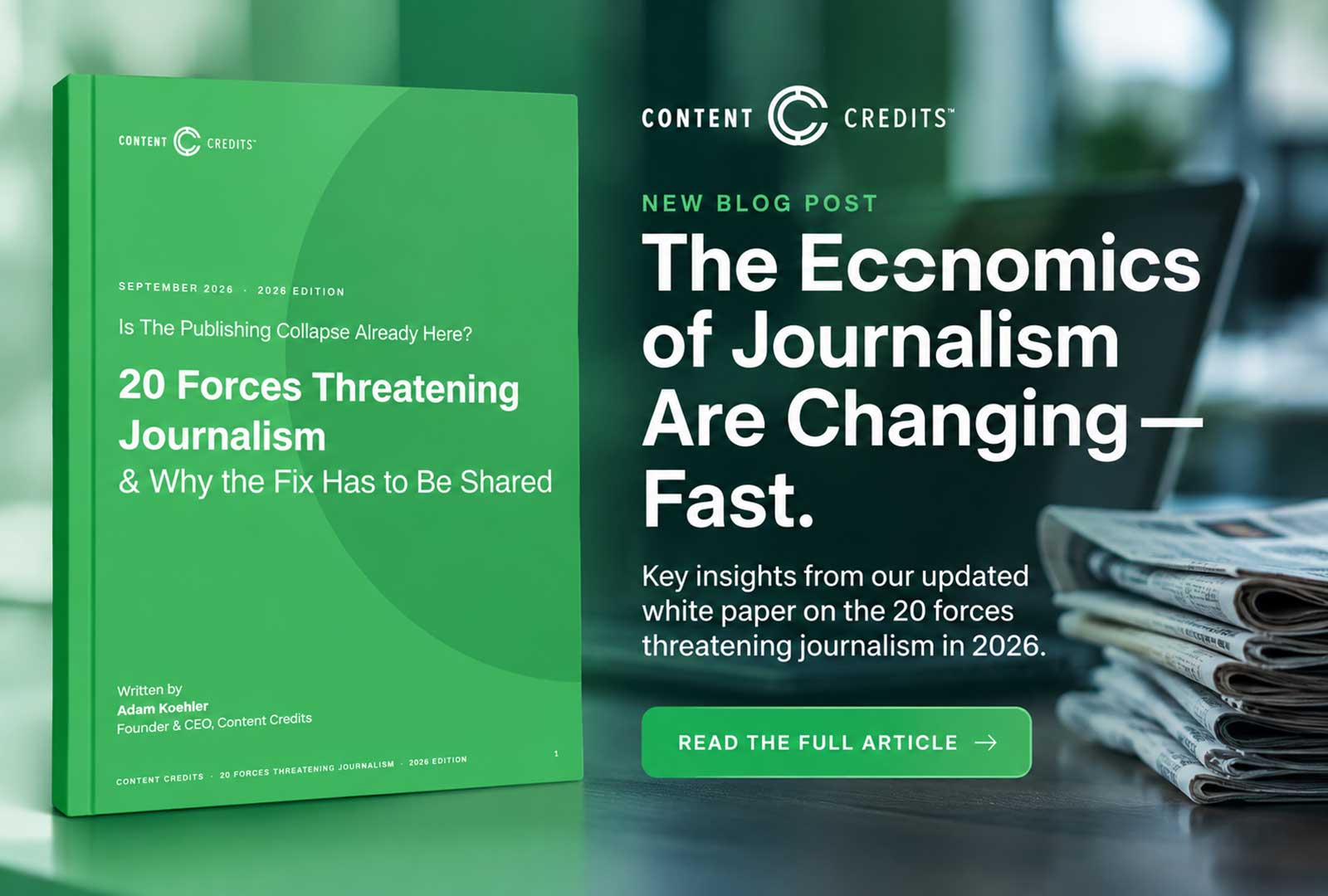
Content Credits’ 2026 White Paper Adds a 20th Threat: Machine Readers
Eighty-three percent of Americans paid nothing for news last year, as publisher search traffic fell 33 percent.
Only eight percent of Americans believe paying for news is anyone’s responsibility.
Those two findings pushed Content Credits to rewrite its 2026 white paper around flexible access.
The original paper came out in July 2025. Fourteen months later, the numbers moved in one direction. Pew Research Center surveyed 3,560 U.S. adults in December 2025. Eighty-three percent had given money to no news source at all that year, no subscription, no donation, no membership.
Chartbeat tracked more than 2,500 publisher sites over the same window. Google organic search traffic to those sites fell 33 percent globally between November 2024 and November 2025. Reuters Institute expects roughly another 43 percent decline over the next three years. Readers still want journalism. They have simply stopped accepting the terms publishers keep offering it on. That gap between wanting and paying is the paper’s actual subject, not any single statistic inside it.
Zero-Click Search Turned From a Forecast Into a Measured 33 Percent Drop
For years the internet ran on an informal trade. Publishers wrote, search engines indexed, and search engines sent readers back to the source. Google’s AI Overviews, AI Mode, ChatGPT, Perplexity and Copilot increasingly answer the question directly, so the visit never happens at all. Pew found that when an AI summary appears above a search result, users click through to a traditional link on just 8 percent of searches. Without a summary, that click-through rate rises to 15 percent. The gap explains the referral collapse better than any single platform decision does. It is why Content Credits treats discovery as the paper’s first and largest force, not one item among twenty.
Subscription Fatigue Is a Business-Model Problem, Not a Marketing One
The obvious fix for falling ad and search revenue has been the subscription. The updated paper’s own numbers argue against leaning on that fix alone. Pew’s December survey found 45 percent of Americans think advertising should fund news. Only 11 percent named subscriptions or memberships. Among readers who actually hit a paywall, just 1 percent pay to get past it.
Subscriptions still work well for a publication’s most engaged readers, and Content Credits is not arguing they should disappear. The gap sits with a different reader, someone who wants this one article and nothing more. That reader does not want a twelfth recurring charge showing up on a bank statement that a cancellation app already flags.
The Paper’s New 20th Threat Is a Reader That Isn’t Human
The 2026 edition adds a threat the original paper did not track: machine readers and agentic access. AI crawlers, retrieval systems, and increasingly agents acting on a person’s behalf now fetch and summarize journalism without a human ever loading the page. Most publishers cannot price that access at today’s rates. They cannot identify who requested it or record what rights they granted.
The paper treats this as an emerging direction, not a shipped product, and Content Credits is careful not to overstate its own machine-payment capability right now. The company’s ledger already logs what content costs a human reader, who accessed it, and what the reader owes the publisher. Extending flexible access to institutional and machine buyers sits on the roadmap. It is not a live revenue line yet.
The question that launched Content Credits as a consumer product was simple: should a reader unlock a single article rather than subscribe to an entire publication? The same flexible-access question now applies to machines. Standards like HTTP 402 and x402 offer early evidence that access is shifting from something browsers assume is free to something systems are built to transact. The paper’s framing puts it plainly. The web is moving from pageviews toward access transactions, first for people and eventually for the software acting on their behalf.
Flexible Access Is Already Live at One Publisher, With a Second Coming
Real publishers are already testing flexible access, not just reading about it. The Southside Sentinel in Virginia runs Content Credits’ first live publisher integration. A second Virginia Press Association member title is now being onboarded under a rollout framework that the association is helping validate. Boone Newsmedia’s questions about subscription protection, reader data, and payment methods directly shaped that pilot framework. They also led Content Credits to add Apple Pay and Google Pay at checkout.
None of this proves the model has scaled. Early Sentinel usage is exactly that: early. The Cincinnati Exchange, the company’s own local newsroom, serves as an internal testbed for the same questions. It tracks how discovery, distribution, and AI referral patterns behave when a real publisher enables flexible access to real articles.
That distinction matters more than any single number in the paper. Content Credits is not claiming to have solved subscription fatigue, ad decline, or AI scraping. It studies those forces because its own product operates inside the same economics publishers are navigating right now. Two U.S. patent applications on the underlying wallet and entitlement system are still pending, another sign that the company treats this as unfinished work rather than a finished pitch. The 2026 edition is simply the current snapshot of what that study has found.
The Update Arrives Ahead of LION’s Sustainability Summit
Content Credits is releasing the updated paper ahead of the LION Independent News Sustainability Summit. Independent publishers gather there specifically to compare notes on business models that might actually hold up. The conversation the company wants at that summit is not a pitch. It is the same question every publisher in the room is already asking. What happens to the reader who values one article, not a recurring relationship with the outlet that published it?
The Washington Post published its own 2026 white paper on flexible payment models. It found an 83 percent conversion rate lift and named Content Credits among the companies building publisher-focused, flexible-payment tools. That citation did not exist when the original 2025 paper was published. Google’s Offerwall launched separately in June 2025 and reported an average 9 percent revenue lift for publishers using it. Neither number belongs to Content Credits directly. The paper attributes both to their original sources rather than borrowing them as its own results.
Read the full “20 Forces Threatening Journalism, 2026 Edition” white paper at contentcredits.com. Publishers attending LION who want to talk through a pilot on their own site can reach Content Credits there as well.